
What is a nonogram?
A nonogram (also called picross, griddler or paint by numbers) is a logic puzzle on a grid. Every cell is either filled or empty. When you have filled the right cells, a hidden pixel picture appears.
A good nonogram has exactly one solution, and you can reach it by logic alone. Every puzzle in Pixwise is built that way.
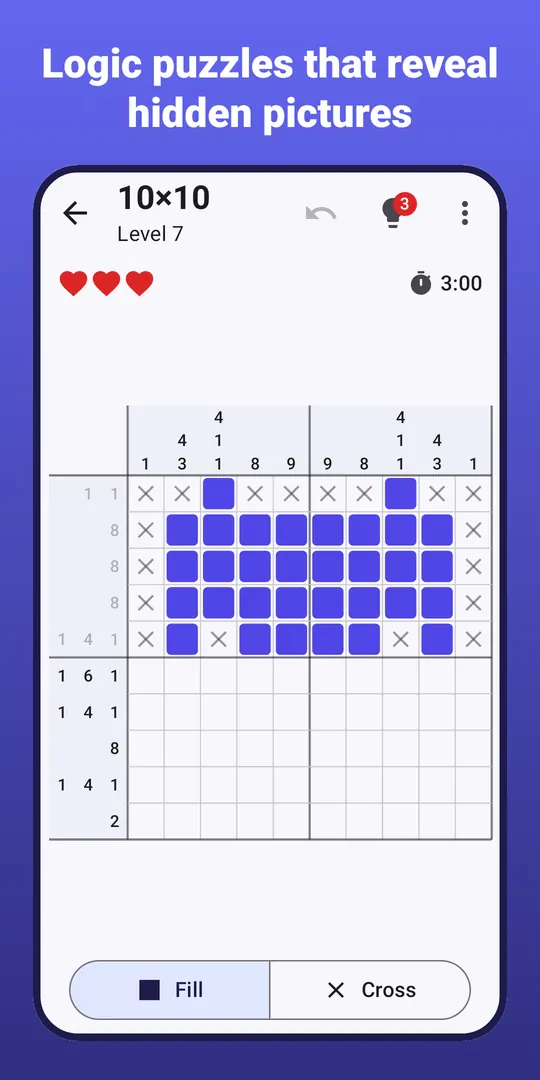
How to read the numbers
The numbers next to each row and above each column are the clues. Each number is a block of filled cells in a row, and the blocks come in that order.
- 3 means one block of three filled cells somewhere in the line.
- 2 1 means a block of two, then at least one empty cell, then a block of one.
- 0 (or no number) means the whole line is empty.
There is always at least one empty cell between two blocks, but there can be any number of empty cells at the ends.
Technique 1: start with the big numbers (overlap)
This is the most useful trick. Imagine a line of 10 cells with the clue 7. Push the block as far left as it goes: it covers cells 1-7. Push it right: it covers cells 4-10. Cells 4 to 7 are filled in both cases, so they must be filled.
The quick rule: clue − (line length − clue) cells in the middle are certain. For 7 in 10 that is 7 − 3 = 4 cells. It works for several blocks too: add the blocks and the gaps (for 3 4 that is 3 + 1 + 4 = 8) and compare with the line length.
Technique 2: complete lines and zeros
If the clues plus the gaps add up exactly to the line length, the whole line is decided. In a 10-cell row, 4 5 = 4 + 1 + 5 = 10, so you can fill it in one go.
A row with clue 0 is completely empty. Cross out all of it at once: every cross also helps the columns.
Technique 3: cross out cells you know are empty
Crosses are as important as filled cells. In Pixwise, switch to Cross and mark every cell you have proved empty. Typical cases:
- a line whose blocks are all complete: cross out the rest;
- cells too far away from a fixed block to belong to it;
- gaps between filled cells that are too small for any remaining block.
Crosses shrink the free space, and smaller spaces make the overlap trick work again.
Technique 4: use the edges
A filled cell touching the edge of the grid or a cross is a fixed starting point. If the first clue of that row is 4 and cell 1 is filled, cells 1-4 are filled and cell 5 must be empty.
The same works one step in: if cell 2 is filled and cell 1 is crossed, the block starts at cell 2.
Technique 5: switch between rows and columns
Never stay on one line for long. Every cell you fill or cross belongs to one row and one column, so each new mark gives the crossing line new information. Solve a row, then check every column it touched, then back again. Big puzzles are solved in this back-and-forth rhythm.
Technique 6: join and split blocks
If two filled cells are close and the line has only one block big enough to cover both, they belong to the same block: fill the cells between them. If a filled group is already as long as the largest clue, it is a finished block: put a cross on both sides.
How to play nonograms in Pixwise
- Pick the Daily puzzle or a pack: Starter 5×5, Easy 8×8, Medium 10×10, Hard 12×12 or Expert 15×15.
- Choose Fill or Cross, then tap a cell or drag along a row or column.
- Stuck? A Hint shows the next logical step, so you learn the technique instead of just getting the answer.
- Solve with no mistakes and no hints to earn 3 stars. Solve the daily puzzle every day to grow your streak.
There are 440 puzzles in total, and every one has a single solution that needs no guessing.
Tips for bigger grids (12×12 and 15×15)
- Scan every row and column once for the overlap trick before anything else.
- Do the long clues first; short clues in a long line rarely give anything early.
- Use crosses generously. On 15×15 grids most of the progress comes from empty cells.
- If you are stuck, look for the line with the least free space left.
- Take a break. A fresh look at the grid often shows the next step at once.
FAQ
Do I ever have to guess in a nonogram?
No, not in a well-made puzzle. Every Pixwise puzzle has exactly one solution that can be reached by logic alone.
Is a nonogram the same as picross or griddlers?
Yes. Nonogram, picross, griddlers, hanjie and paint by numbers are different names for the same kind of logic picture puzzle.
What size should a beginner start with?
Start with 5×5 grids to learn the rules, then move up to 8×8 and 10×10. In Pixwise the Starter and Easy packs are made for this.
Is Pixwise free?
Yes. Pixwise is free on Android with ads. An optional one-time Pro purchase removes ads and unlocks unlimited hints and the Expert 15×15 pack.
Pixwise · Logic picture puzzles: fill the grid, reveal pixel art.
Get it on Google Play